English


Choosing the best Wooden Door Hinge in 2026 requires more than comparing finish, price, or online ratings. Global buyers must examine door weight, opening frequency, climate, installation accuracy, and replacement access. A hinge that performs well in a dry showroom may develop corrosion beside a coastal entrance. Small details matter.
The UNEP and Global Alliance for Buildings and Construction 2024 Global Status Report states that buildings consumed about 32% of global energy and produced approximately 34% of global carbon emissions in 2022. This wider pressure is influencing material selection, product life, and maintenance decisions. Door hardware is a small component, yet durable hinges can reduce repair frequency and material waste. The World Green Building Trends research also shows continued international interest in efficient, durable, and environmentally responsible building products.
This guide compares butt hinges, ball-bearing hinges, concealed hinges, spring hinges, and specialty wooden-door options. It considers load capacity, cycle testing, corrosion resistance, screw geometry, adjustment range, and compatibility with timber movement. Relevant references include ANSI/BHMA A156.1 for architectural hinges, EN 1935 for single-axis hinges, and ISO 9227 for salt-spray corrosion testing. These standards support better procurement decisions, but they do not remove every uncertainty.
There is no universal winner.
A heavy oak door may need ball-bearing support, while a light interior door may perform adequately with a simpler butt hinge. Budget, finish, and local service also influence the final choice. Some supplier claims remain difficult to verify. Buyers should request test evidence, installation guidance, and sample approval before placing large international orders.
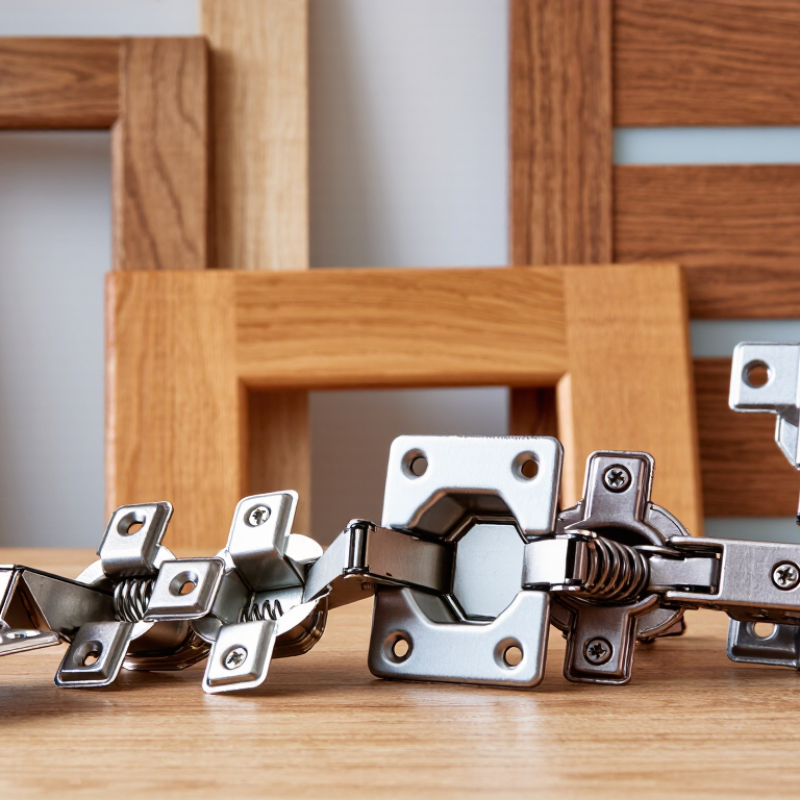
Wooden door hinges are compact load-bearing systems, not merely decorative fittings. A typical hinge includes leaves, a knuckle, a pin, and fixing holes. The leaves transfer door weight into the frame. The knuckle controls rotation. The pin keeps both leaves aligned during repeated movement. Small parts matter.
Common types include butt hinges, ball-bearing hinges, concealed hinges, and pivot hinges. Butt hinges suit many interior timber doors because their structure is simple and serviceable. Ball-bearing models reduce friction on heavier doors. Concealed hinges protect the visual line, but installation demands accurate routing. Pivot hinges support wider movement and unusual door layouts. In practice, the best choice depends on door mass, opening frequency, frame strength, and desired appearance.
Material selection affects durability. Stainless steel resists moisture and staining, while brass offers a warmer appearance and workable corrosion resistance. Zinc alloys may lower cost, but their strength can vary significantly. The 2024 Mordor Intelligence Door Hardware Market report estimates continued market growth through 2029, driven partly by renovation and higher-performance hardware demand. That trend does not make every hinge suitable. A 2023 ASTM-related testing review found that cyclic testing, load capacity, and corrosion exposure remain important performance checks for architectural hardware. Buyers should compare test evidence, not only surface finish. I still see projects choosing attractive hinges with undersized screws. That is a preventable mistake.
QUICK LINKS
CONTACT US
Office: (+86) 755 23040566
Tel: (+86) 158 9965 5195
E-mail: sale@pcbledmodule.com
Skype: Hans@Rocket-PCB
Whatsapp: 86 1589965 5195
Office Address: 2207,Bid 4,He Gu Shan Hui Cheng,35#,Guang Tian RoYanluo street, Song Gang Town,518105 SHENZHENG, CHINA
Plant ADD.: No 69, Lianfeng North Road, Xianxi Area, ChangAn Town, Dongguan, China.


Copyright © 2025 Rocket PCB Solution Ltd. | All Rights Reserved Sitemap Friendship link: CNC machining heat sink