

Range Exhaust is more than a metal canopy above a stove. It is a source-control system that captures smoke, grease, moisture, combustion by-products, and cooking odors before they spread through the home. A well-designed hood pulls contaminated air into a filter, moves it through ductwork, and releases it outdoors. Recirculating models filter and return air indoors, but they cannot remove moisture or every gaseous pollutant.
The numbers matter. Home Ventilating Institute guidance commonly recommends about 100 cubic feet per minute for a wall-mounted hood and higher airflow for island installations. Its certified performance data also shows why advertised airflow can mislead. Actual results depend on duct length, elbows, filters, and termination design. ENERGY STAR and U.S. Department of Energy research likewise emphasize efficient ventilation and proper installation, rather than maximum fan power alone. Bigger is not always better.
Dr. Brett Singer, an indoor-air-quality researcher at Lawrence Berkeley National Laboratory, has emphasized, “The most important thing is to capture the pollutants at the source.” That principle explains the value of a properly sized Range Exhaust system. It should sit close to the cooking surface, cover the active burners, and use smooth, short ductwork whenever possible. Still, no single setup fits every kitchen. Gas cooking, induction, wok burners, ceiling height, and makeup air requirements change the design. This article examines how Range Exhaust works, how professionals evaluate performance, and where common assumptions fall short. Some kitchen advice sounds simple. Real installations rarely are.
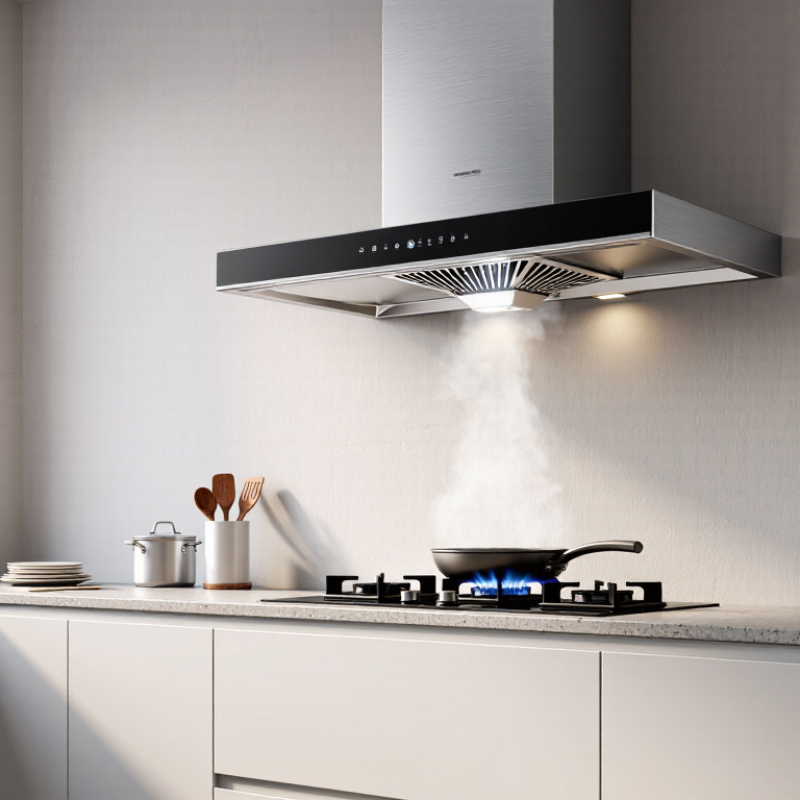
What Is a Range Exhaust?
A range exhaust is a mechanical system that removes cooking fumes from above a stove. It usually includes a canopy, grease filters, a fan, and an air outlet. When the fan runs, it captures steam, smoke, oil particles, heat, and cooking odors. A ducted system sends this air outdoors. A recirculating system passes air through filters and returns it indoors.
The common explanation is incomplete. A filter does not make polluted air disappear. It mainly traps grease, while an activated-carbon filter can reduce some odors. Fine particles may still remain, especially during frying or high-heat cooking. The U.S. Environmental Protection Agency reports that indoor pollutant levels can be two to five times higher than outdoor levels. Cooking is one important indoor source.
Airflow also matters. ASHRAE Standard 62.2-2022 lists 100 cubic feet per minute for intermittent kitchen exhaust and 25 cubic feet per minute for continuous operation. These figures are useful references, not universal guarantees. A weak fan, blocked filter, or poorly designed duct can reduce performance. I have found that people often judge a range exhaust by noise alone. That is unreliable. Quiet operation may feel comfortable, but capture depends on airflow, hood position, duct resistance, and cooking habits. Even a powerful unit can miss steam from a tall pot placed near the front burner.
A practical overview of range exhaust systems, their components, and typical operating characteristics.
| Data Dimension | Typical Data or Specification | What It Means |
|---|---|---|
| Definition | A mechanical ventilation system installed above or near a cooking surface | Range exhaust, commonly called a range hood or cooker hood, captures airborne grease, smoke, steam, heat, and cooking odors. |
| Main Operating Process | Capture, filter, and discharge or recirculate air | A fan draws contaminated air into the hood. Filters remove grease particles, and the air is either exhausted outdoors or returned to the room after additional filtration. |
| Exhaust Configuration | Ducted or ductless | Ducted systems send air outdoors through a ventilation duct. Ductless systems use grease and activated-carbon filters, then recirculate the filtered air indoors. |
| Typical Airflow | Approximately 100–600 CFM for many residential installations | CFM means cubic feet per minute. Required airflow depends on cooking style, appliance output, hood size, duct design, and local building requirements. |
| Recommended Coverage | The hood should generally be at least as wide as the cooking surface | A wider hood can improve capture, especially when cooking produces strong heat or when the hood is installed against a wall or above an island. |
| Installation Height | Often about 24–30 inches above an electric cooking surface and 30–36 inches above a gas surface | The correct distance varies by hood design, cooking appliance, safety guidance, and local code. Excessive height can reduce capture effectiveness. |
| Grease Filtration | Washable metal mesh or baffle filters | These filters trap grease before it enters the fan and duct. Cleaning frequency depends on cooking frequency and the amount of frying or grilling. |
| Odor Filtration | Activated-carbon filters are mainly used in ductless systems | Carbon filters can reduce some cooking odors, but they do not provide the same moisture and heat removal as a properly ducted exhaust system. |
| Lighting Function | Integrated task lighting, commonly LED or other low-energy lighting | Lighting improves visibility over the cooking area but does not contribute directly to ventilation performance. |
| Noise Level | Often about 40–70 dBA, depending on fan speed and installation | Higher airflow settings usually produce more sound. Short, smooth, correctly sized ductwork can help reduce operating noise. |
| Duct Design | Smooth, rigid, appropriately sized metal ducting is generally preferred | Fewer bends and shorter duct runs usually improve airflow. The duct should terminate outdoors with a suitable exterior cap and backdraft damper. |
| Energy Effect | Exhausted conditioned air is replaced by makeup air or air entering the building | High-airflow systems can affect heating and cooling loads. Makeup-air requirements may apply in some locations and for certain airflow levels. |
| Primary Benefits | Improved indoor air quality and cleaner kitchen surfaces | A properly used range exhaust can reduce airborne grease, excess humidity, smoke, heat, and cooking odors in the kitchen. |
| Maintenance Schedule | Clean grease filters regularly; replace carbon filters as needed | Maintenance intervals depend on usage. A dirty filter can restrict airflow, increase noise, and create a greater grease-accumulation risk. |
| Best Use Case | Ducted ventilation for frequent, high-heat, or high-grease cooking | Ductless ventilation can be useful where outdoor ducting is impractical, but it is generally less effective at removing heat and moisture. |
Note: Actual airflow, installation height, duct dimensions, noise, and makeup-air requirements should be confirmed using the appliance instructions and applicable local building and ventilation codes.
What Is Range Exhaust and How Does It Work?
How Range Exhaust Captures Cooking Smoke and Odors
A range exhaust system pulls rising smoke, steam, grease, and odors away from the cooking surface. Its fan creates airflow beneath the hood. This airflow guides contaminated air into grease filters, which trap oil particles before they spread across cabinets and walls. Ducted systems then send the filtered air outdoors through a sealed ventilation path. Recirculating systems clean the air with a carbon filter and return it indoors. They are convenient, but they usually remove less moisture and odor.
Strong performance depends on more than fan speed. The hood should cover the main cooking area and sit at the correct height. A steady airflow often works better than maximum power, which can create unnecessary noise. During frying, I notice that turning the exhaust on several minutes early improves capture. Yet it is not perfect. Steam may escape from wide pans, especially near the front burners. Open windows, cross-drafts, and an undersized duct can also reduce effectiveness.
Tips: Clean metal grease filters regularly, following the appliance instructions. Replace carbon filters when odors remain after cooking. Keep the exhaust running for ten to fifteen minutes afterward. Wipe nearby surfaces often. A clean filter supports airflow.
How range exhaust captures cooking smoke, grease particles, heat, moisture, and odors
Range exhaust works by drawing contaminated air into a hood above the cooking surface. Grease filters capture much of the airborne grease, while the fan moves smoke, moisture, and odor-bearing gases through a duct and outdoors. The chart shows common airflow values converted from cubic feet per minute (CFM) to cubic meters per hour (m³/h). Higher airflow can remove contaminated air more quickly, although actual capture also depends on hood coverage, installation height, duct design, and cooking conditions.
Conversion used: 1 CFM = 1.699 m³/h. Airflow alone does not guarantee complete smoke or odor capture.
A range exhaust system removes smoke, grease, heat, and cooking odors from above the cooktop. Its hood captures rising air through a canopy or underside panel. A blower then pulls this air through grease filters. The filtered air travels through ductwork and exits outdoors in a properly installed system. Recirculating models pass air through additional odor filters before returning it indoors. They reduce odors, but they do not remove heat or moisture as effectively.
The grease filters are essential. They trap oily particles before those particles reach the blower and ducts. Stainless steel filters are washable, while disposable filters require regular replacement. The blower provides the airflow needed for capture. Higher airflow is not always better. Excessive suction can increase noise and pull conditioned air from the room. A backdraft damper helps stop outdoor air, dust, and insects from entering through the duct.
Controls usually adjust fan speed and lighting. Some systems include heat sensors or automatic shutoff features. Duct size, length, bends, and termination all affect performance. A narrow or sharply bent duct can weaken airflow noticeably. In practical kitchen checks, filters are often dirtier than expected, even when the hood appears clean. That small oversight can reduce capture efficiency. Installation details matter as much as the hood itself. Even a powerful blower cannot fully correct poor duct routing or an incorrectly positioned hood.
Range exhaust removes smoke, grease, heat, and cooking odors from above a cooktop. Its performance depends on the exhaust type and ventilation method. A ducted range hood captures airborne particles and sends them outdoors through a sealed duct. This is usually the most effective option for frequent frying, grilling, or high-heat cooking. Proper duct size, short runs, and smooth bends help maintain airflow. Installation should follow local building requirements and electrical safety standards.
A recirculating hood uses filters to trap grease and reduce odors before returning air indoors. It is easier to install, but it cannot remove moisture or heat completely. Filters need regular cleaning or replacement. Downdraft ventilation pulls air downward through a rear or central intake. It can suit island cooktops, although rising steam naturally works against it. Ceiling-mounted systems offer a cleaner appearance, but they require careful positioning and stronger airflow. Small design errors matter.
Tips: Keep the hood slightly wider than the cooking surface when possible. Start ventilation before cooking, not after smoke spreads. Clean metal filters often. Check airflow with a thin tissue near the intake. If it barely moves, the duct may be restricted. Even experienced cooks can underestimate steam from boiling pots. I have found that quieter systems are not always weaker, but sound ratings alone can mislead. Compare airflow, duct design, and real cooking habits together.
What Is Range Exhaust and How Does It Work?
How to Choose and Maintain a Range Exhaust
A range exhaust hood captures smoke, grease, steam, and cooking odors above the cooktop. Its fan pulls contaminated air through a filter. Ducted models send that air outdoors, while recirculating models clean it and return it indoors.
Choose a hood that matches your cooking habits and kitchen layout. Measure the cooking surface before shopping. The hood should usually be at least as wide as the range. Strong burners and frequent frying need better airflow. A quiet motor also matters in an open kitchen. Ducted exhaust often performs better, but the duct route must be short, smooth, and properly sealed. Local installation requirements may affect the final design.
Maintenance protects performance and indoor air quality. Clean metal filters every month with warm water and mild detergent. Heavy cooking may require weekly cleaning. Wipe the hood surface before grease becomes sticky. Check the fan, lights, and duct opening for unusual noise or weak airflow. I once underestimated how quickly grease could build up behind a filter. That small oversight made cleaning much harder. Replace damaged filters, and ask a qualified technician to inspect electrical or ductwork problems. Do not ignore vibration. It can indicate loose parts or an unbalanced fan. Even a well-chosen hood needs regular attention.
QUICK LINKS
CONTACT US
Office: (+86) 755 23040566
Tel: (+86) 158 9965 5195
E-mail: sale@pcbledmodule.com
Skype: Hans@Rocket-PCB
Whatsapp: 86 1589965 5195
Office Address: 2207,Bid 4,He Gu Shan Hui Cheng,35#,Guang Tian RoYanluo street, Song Gang Town,518105 SHENZHENG, CHINA
Plant ADD.: No 69, Lianfeng North Road, Xianxi Area, ChangAn Town, Dongguan, China.


Copyright © 2025 Rocket PCB Solution Ltd. | All Rights Reserved Sitemap Friendship link: CNC machining heat sink