
English


Choosing the right Verctical Lift Conveyor begins with the process, not the product brochure. A lift may move cartons between floors, mezzanines, or automated storage zones. Yet its real value depends on load shape, transfer speed, footprint, safety controls, and maintenance access. A narrow platform serving sealed cartons needs different engineering from a system carrying irregular pallets.
Market pressure makes these decisions more important. The MHI 2024 Annual Industry Report found that 55% of supply chain leaders expect to increase technology and innovation spending over the next two years. The report also identifies labor shortages and operational resilience as continuing concerns. A poorly selected conveyor can worsen both problems. Downtime becomes visible quickly: stalled cartons, blocked aisles, and operators waiting beside a lift.
John Paxton, former CEO of MHI, has described supply chains as being in “a period of rapid change and disruption.” That observation applies directly to vertical material handling. Equipment must support today’s throughput without trapping tomorrow’s layout. CEMA guidance also stresses matching conveyor design with the application, load, and operating conditions. That sounds obvious. It is often missed.
The following seven tips examine capacity, lift height, load stability, controls, guarding, serviceability, and total cost. Field experience matters here. Measure the actual carton, not the ideal carton. Check peak demand, not average demand. And question impressive specifications. A faster lift may still create a slower system if transfers are poorly aligned. Some choices will remain uncertain, but disciplined evaluation reduces expensive surprises.
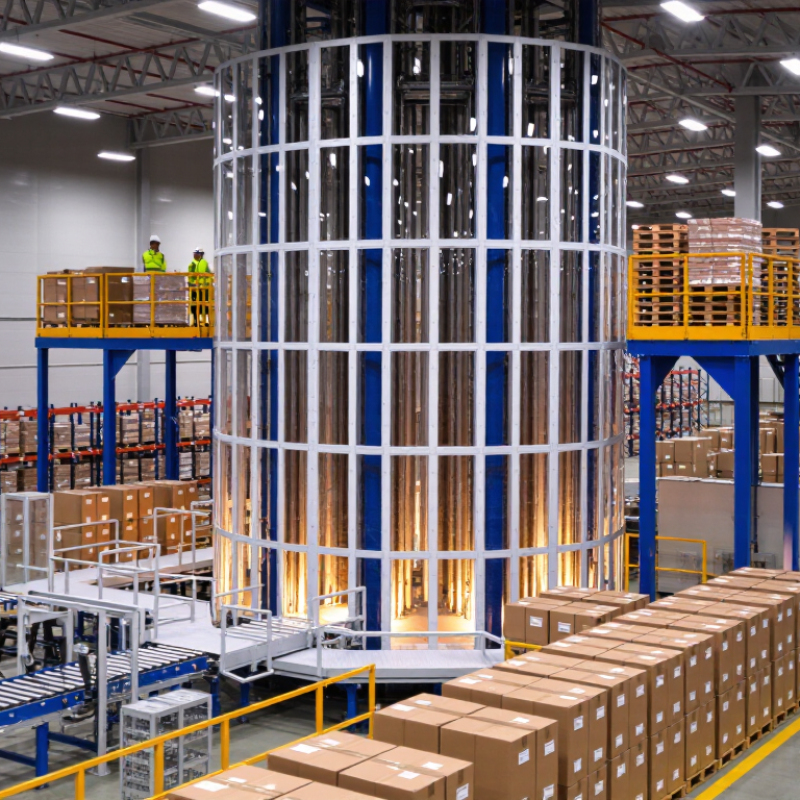
A vertical lift conveyor should solve a defined movement problem, not fill unused space. Map the load’s starting point, destination, elevation change, and handoff points. Then measure product weight, dimensions, speed, and daily cycles.
MHI’s 2024 Annual Industry Report found that 55% of supply-chain professionals planned to increase technology investment. That investment still needs a clear operating purpose.
Choose the lift according to the flow around it. Check accumulation needs, conveyor interfaces, floor openings, guarding, access, and emergency controls. Consider whether pallets, cartons, totes, or mixed loads will travel vertically.
Interact Analysis projected the warehouse automation market to exceed 40 billion dollars by 2027, showing strong demand for automation. Demand alone is not a design brief.
Walk the proposed route with operators and maintenance staff. Their practical experience can reveal blocked aisles, awkward loading heights, and cleaning problems. Review cycle time at peak demand, not during a quiet shift. A lift rated for average volume may struggle during promotions.
That assumption is often wrong.
Ask for energy use, spare-part access, inspection intervals, and documented safety performance. Pilot testing remains valuable, even when the layout looks obvious.
A small trial may expose unstable loads, poor handoffs, or operator delays before installation.
QUICK LINKS
CONTACT US
Office: (+86) 755 23040566
Tel: (+86) 158 9965 5195
E-mail: sale@pcbledmodule.com
Skype: Hans@Rocket-PCB
Whatsapp: 86 1589965 5195
Office Address: 2207,Bid 4,He Gu Shan Hui Cheng,35#,Guang Tian RoYanluo street, Song Gang Town,518105 SHENZHENG, CHINA
Plant ADD.: No 69, Lianfeng North Road, Xianxi Area, ChangAn Town, Dongguan, China.


Copyright © 2025 Rocket PCB Solution Ltd. | All Rights Reserved Sitemap Friendship link: CNC machining heat sink